Nicholasville, KY · Garage Door Service
What Nicholasville's Older Housing Stock Means for Your Garage Door
Nicholasville homes built mostly between 1956 and 1991 means older torsion springs and worn tracks. Here's what to check first before calling for repair.
- Repairs & new doors
- Springs & openers
- Serving 7 nearby communities
The Problem
Most houses across Nicholasville's service area went up between 1956 and 1991, with the median build year sitting at 1971. That's not ancient, but it's old enough that a lot of original garage door hardware is still hanging on by habit, not by condition. A torsion spring wound in 1971 and never replaced has outlived its rated cycle count several times over. Tracks installed when a house was framed have seen fifty-plus years of seasonal swelling and settling.
Across the seven named areas we work in - from Wilmore in close to Deerfield and the Beaumont Residential area further out - the stock is overwhelmingly 1960s and 70s construction. That means a lot of single-car and two-car doors on side-mounted torsion setups that were standard for the era but aren't what gets installed new today. When a spring finally lets go, or a cable frays through, it's usually on a door that's been quietly wearing down for decades, not failing out of nowhere.
The problem isn't that these doors are bad. It's that nobody's been checking them, because nothing dramatic happens until the day it does.
What Most People Get Wrong
The most common mistake is blaming the opener. A door that's slow, noisy, or won't close all the way gets a new opener motor, and the real issue - a worn roller, a track that's walked out of alignment over fifty years, a spring that's lost tension - never gets touched. The opener didn't cause the problem; it's just the part doing the most visible work, so it takes the blame.
With 12,635 households and 5,883 owner-occupied houses in this service area, a lot of these doors are original to homes built before current insulation rules, which means the door panel itself may be a single layer of steel with no thermal break. Homeowners sometimes replace an opener twice before anyone looks at the door itself and asks whether it's even balanced anymore.
At a median household income of $59,609, most owners here aren't looking to replace a whole door system when a spring job or a track realignment will do. That's usually the right call. But it only works if someone actually checks the door and hardware first, instead of guessing from the opener backward.
What to Look At First
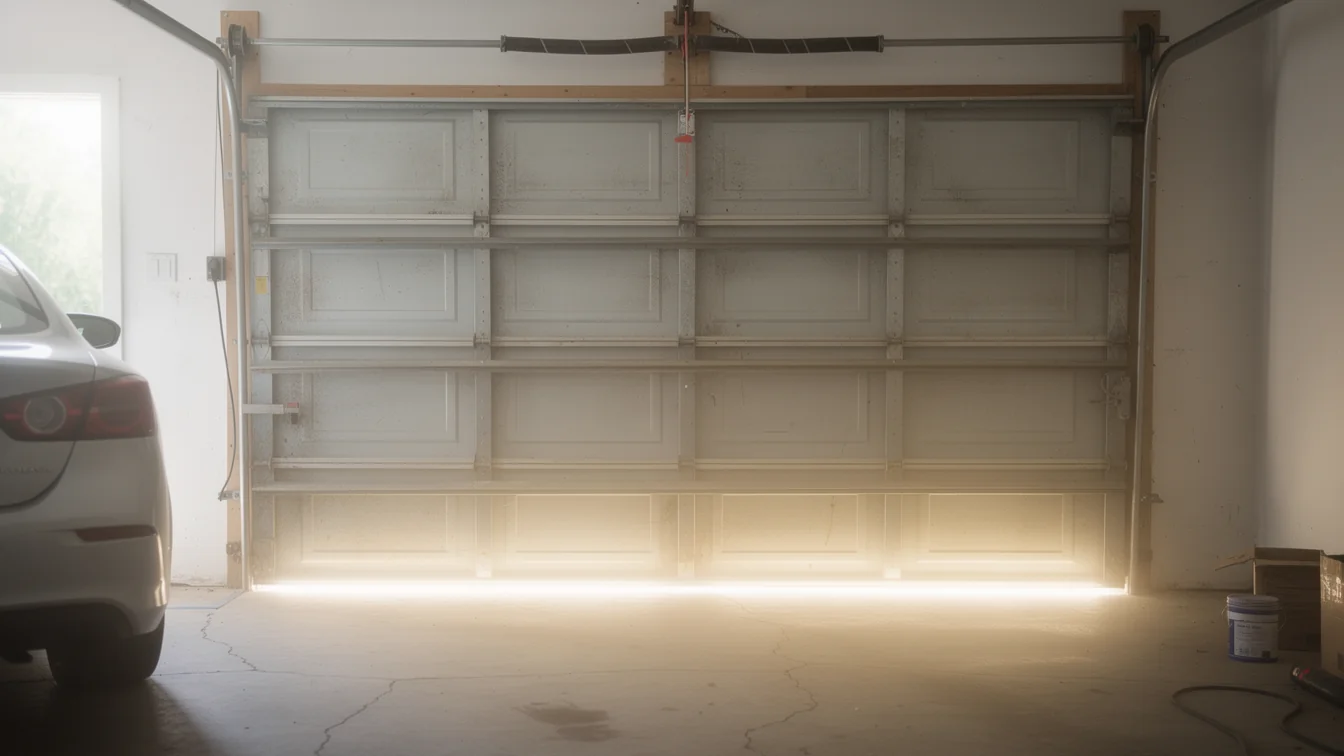
Start with the spring, not the opener. Stand the door up by hand with the opener disconnected - if it doesn't hold roughly where you let go, the spring is losing tension and that's your real problem, not the motor.
Next, look at the rollers and track. On houses from the 1960s and 70s, original steel rollers have usually gone through decades of friction without anyone lubricating them, and the track itself can bow slightly where it's bolted to an aging frame. A door that binds or jumps on one side, more than the other, is telling you where the track has drifted.
Check the cables too, especially if the door has never had them replaced. A fraying cable on an older torsion system is one of the more dangerous things to leave alone, since it's under real load the moment the door starts to move.
Last, look at the weatherstripping along the bottom and sides. On a lot of the older doors in this area it's cracked or missing outright, which matters more here than it would somewhere warmer.
What the Weather Here Does to It
This area sits in a cold moderate climate band, which means the door hardware goes through real freeze-thaw cycling every winter, not just an occasional cold snap. Steel springs and tracks installed in the 60s and 70s were built for the standards of their time, and that time didn't account for fifty winters of expansion and contraction on the same metal.
Cold makes steel springs stiffer and more brittle right at the moment a homeowner is asking the most of them - heavy doors, cold mornings, a motor working harder to overcome stiff hardware. That's often when an old spring finally snaps, rather than during a mild month.
Moisture is the other half of it. Freeze-thaw cycling pushes water into any gap in old weatherstripping, and on an uninsulated single-layer panel - common on houses built before insulation rules - that moisture has nowhere to go. Wood trim around the opening can swell and bind the door, which gets misread as a track problem when it's really a seasonal moisture issue specific to how these older openings were built.
Frequently asked questions
My garage door is original to the house. Is it worth fixing or should I replace it?
Depends what's actually worn. If the panel itself is sound and it's a spring, cable, or roller issue, repair makes sense, especially on a single-layer door from the 60s or 70s where replacement cost jumps fast. If the panel is rusted through or badly warped, repair stops being worth it. We can tell you which one you've got after a look.
Why does my door get harder to open every winter?
Cold stiffens steel springs and thickens old lubricant, so the opener and the spring are both working harder right when temperatures drop. On a door with original hardware from this area's typical 1960s-70s builds, that seasonal strain is often what finally reveals a spring that was already near the end of its life.
Do you work outside Nicholasville itself?
We cover the surrounding service area, including places like Wilmore, Deerfield, and the Beaumont Residential area. Reach out through the contact page and we'll confirm whether your address falls within the area we run jobs in.
Related garage door services in Nicholasville
More garage door guides
Book garage door service in Nicholasville
Call now or request a quote - tell us what the door is doing and where you are.