Nicholasville, KY · Garage Door Service
Garage Door Installation for Nicholasville Homes
New garage door installation for Nicholasville homes built mostly between 1956 and 1991 - sized right, insulated for a cold winter, and fitted to openers that still work.
- Repairs & new doors
- Springs & openers
- Serving 7 nearby communities
What the Fix Involves
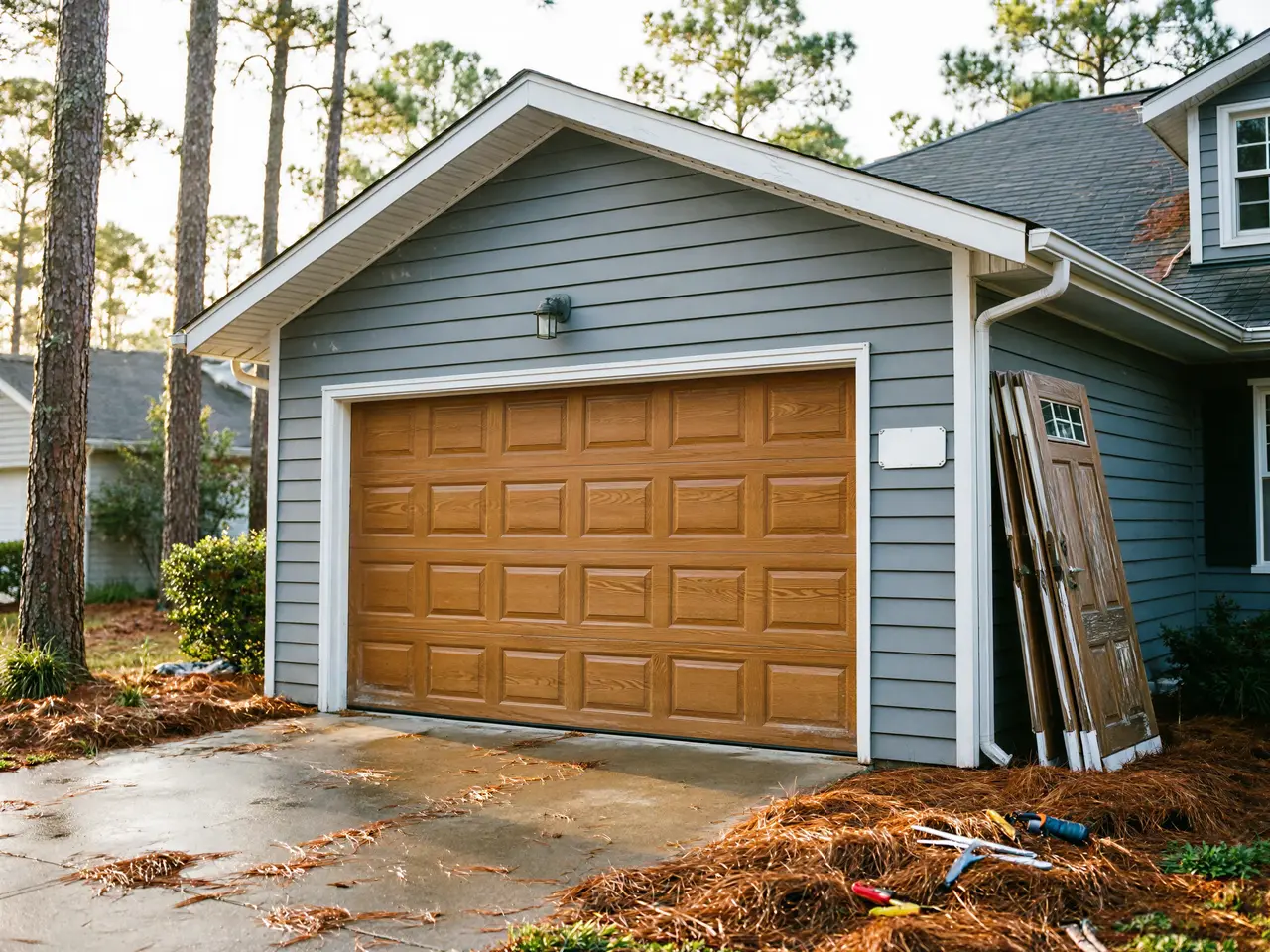
A proper installation isn't just hanging a new slab where the old one hung. We pull the old door, track, and torsion hardware off the jamb, check the framing underneath (a lot of it has shifted slightly over fifty-plus years), and set new vertical tracks plumb before anything gets wound tight. On a house from the 1960s or 70s stock that makes up most of this area, the opening is often a non-standard width by today's door sizing - builders in that era worked to local lumber yards, not a national spec sheet.
We measure the rough opening, not the old door, because the old door may have been trimmed or shimmed to fit crooked framing decades ago. New springs get sized to the actual weight of the panel you're installing, not guessed from the old spring's wind count. If you're keeping the existing opener, we check the rail length and the logic board's age before we commit it to a heavier insulated door - some older openers can't handle the added weight safely.
The one thing we don't do: reuse a cracked or hourglassed torsion spring to save a trip charge. If it's original to a house built before 1991, it's past the point where that's a reasonable gamble.
The Symptom
The door people call us about is rarely silent failure - it's usually a door that still runs but runs wrong. A single steel panel door from the 1960s or 70s, with no insulation core, sweats on the inside face every time the temperature swings, which is common in this area's cold moderate climate. That moisture works into the bottom panel seams over the years and you start seeing rust lines at the weatherstrip track, or the bottom section starts to sag a half inch off square.
Other owners notice the opener straining - grinding, slow starts, or stalling halfway up - because the door's actual weight has crept up from rust and water absorption in the wood or steel, while the springs were sized for the door's original, lighter weight.
And some of it's just cosmetic exhaustion: thirty-plus years of sun and cold cycling leaves a steel door chalky and the seams visibly separated, even if the hardware's technically still working. None of these are emergencies. All of them are the kind of thing that gets worse every winter you leave it.
Why This Fails Locally
The housing stock across the seven named areas in Nicholasville's service footprint runs 1956 to 1991, with the median build year landing around 1971. That's the exact window when steel garage doors went mainstream but insulated cores were still rare or optional - so a huge share of original doors here are single-skin steel with no thermal break at all.
Pair that with the area's cold moderate climate band and you get a predictable failure path: temperature swings drive condensation on the door's inside face, and condensation sitting on bare steel for forty-plus winters is what actually eats the bottom panel and the track hardware, not age by itself.
It's not just the town center - the same era of construction shows up out toward Wilmore, five miles off, and in the Deerfield, Beaumont, and Hamburg-area subdivisions eight to twelve miles north and northeast. Those neighborhoods were built in roughly the same stretch, with the same door and opener specs, which means the failure timeline tracks closely across all of them. A door that's starting to sag or rust in one of these areas is on the same clock as its neighbors, not an outlier.
How Long It Takes
A single-door replacement on a standard opening, with the track and springs swapped to match, is typically a one-day job start to finish - we don't leave an opening uncovered overnight. Double-door jobs with heavier insulated panels run longer because the torsion setup is more involved and two people are standing a 16-foot section instead of an 8-foot one.
Where it stretches out is non-standard openings. Some of the older homes in this area's 1956-1991 stock were framed to openings that don't match a current factory size, and getting a door built to that exact width isn't a same-day part - it's a special order, and lead time depends on the manufacturer's current backlog, which we won't promise a number on until we've got your measurements in hand.
If you're also swapping the opener, add an hour or two for wiring and safety sensor alignment, but that doesn't usually push the job past a single day unless the electrical run needs work too.
Frequently asked questions
Will a new garage door fit my old opening without resizing the frame?
Usually, yes. Most standard single and double openings from the 1960s-90s match current door sizing closely enough that we can install without touching the framing. Where it's off, it's typically by an inch or two, which we can usually absorb with trim and weatherstrip rather than reframing the opening.
Do I need a new opener when I get a new door?
Not always. If your current opener is in good shape and rated for the new door's weight, we can reuse it. Heavier insulated doors sometimes exceed what an older opener's motor and gearing were built for, so we check the rail length and lift capacity before recommending you keep it.
How much does insulation actually matter for a garage door here?
In this area's cold moderate climate, an insulated core keeps the inside face of the door above the dew point more often, which cuts down on the condensation and rust that eat uninsulated steel doors from the inside out. It also keeps an attached garage noticeably less cold in winter.
What if my garage door opening is a weird size?
It happens, especially on houses built before national sizing standards were common. We measure first and tell you honestly if a standard door will work or if you need a special-order size, which takes longer to get in and costs more than a stock door.
Book garage door service in Nicholasville
Call now or request a quote - tell us what the door is doing and where you are.